
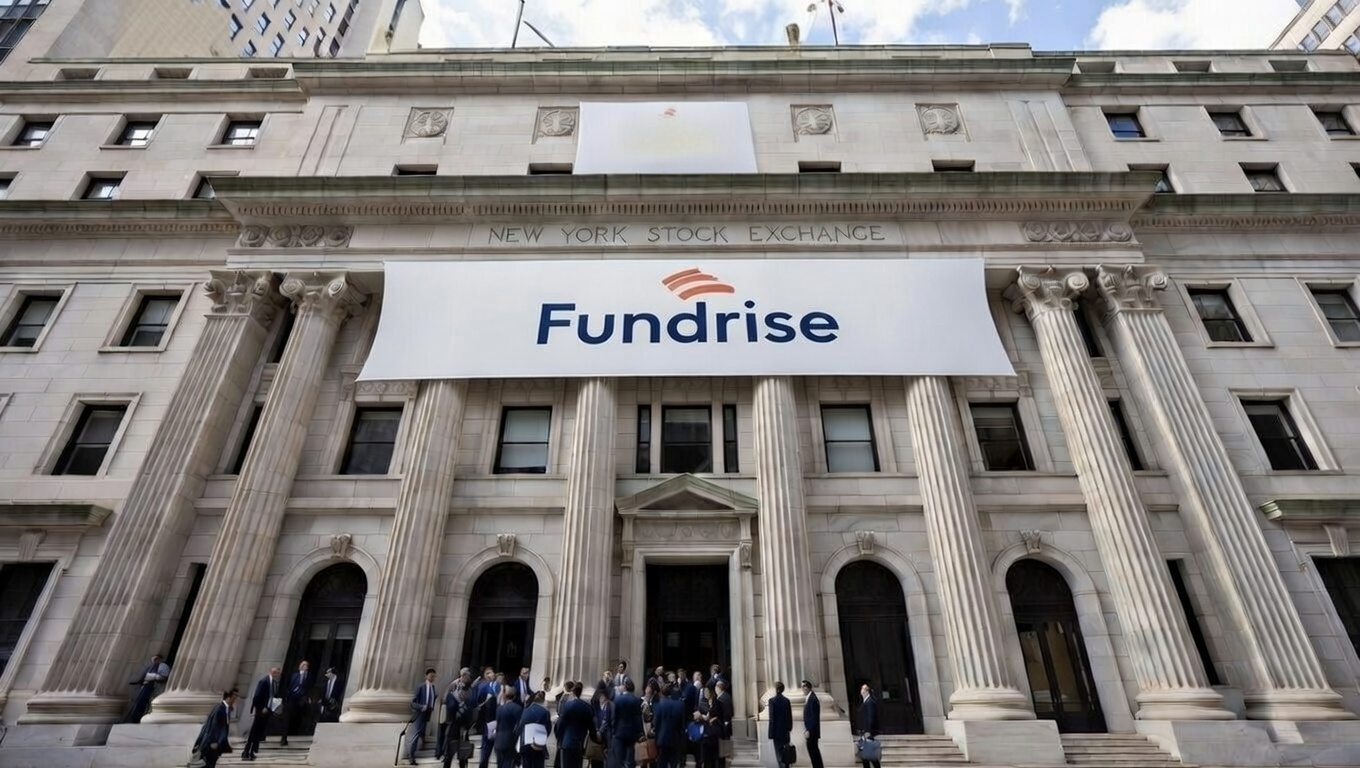

One of the reasons I’ve been a long-time fan and affiliate partner of Fundrise is its willingness to innovate. Since its founding in 2012, shortly after the JOBS Act opened private real estate investing to retail investors, Fundrise has consistently looked for ways to democratize access to institutional-quality investments.
From launching diversified real estate funds like its Heartland and Income funds, to expanding into venture capital through the Innovation Fund, Fundrise has steadily pushed into areas that were once reserved for large institutions and ultra-high-net-worth individuals.
So when I received an email from Fundrise announcing its plans to list the Innovation Fund on the New York Stock Exchange, under the ticker VCX, I was intrigued.
As someone who has been investing in the Innovation Fund since 2023, with over $700,000 invested, my initial reaction was mixed. I tend to be old-school when it comes to investing. If something isn’t broken, I’m generally reluctant to change it.
Here are my initial thoughts on the Innovation Fund potentially listing on the NYSE after a day of digesting the news. I’ll update this post as I learn more and continue to refine my views.
The Potential For Instant Liquidity In Venture Capital
I’ve invested in traditional venture capital funds for over 15 years. That experience has conditioned me to expect zero liquidity for a long time. When I allocate capital to venture, typically up to about 20% of my investable assets, I assume I won’t see that money again for at least 10 years.
The other 80% of my portfolio provides liquidity. Stocks, bonds, and even cryptocurrencies can be sold if cash is needed or if opportunities arise. Venture capital, by contrast, is meant to be patient capital.
Fundrise already offers quarterly liquidity for the Innovation Fund, which is relatively generous by venture standards. But providing that liquidity comes at a cost, one I didn’t fully appreciate at first.
To meet quarterly redemption requests, roughly up to 30% of the Innovation Fund has been allocated to liquid, lower-risk assets such as money market funds and corporate bonds. These assets provide stability and liquidity, but they also dilute returns during strong markets.
For example, in 2025, the Innovation Fund returned about 43.5%, driven largely by exceptional performance from core holdings like OpenAI, Anthropic, Anduril, and Databricks. Meanwhile, money market funds averaged roughly 4% and corporate bonds about 6%.
When 30% of a fund is earning a blended return closer to 5%, that acts as a meaningful drag during bull markets, much like holding excess cash in a rapidly rising portfolio. During strong markets, there was little redemption pressure anyway, as investors wanted to stay invested and often add more.
An NYSE Listing Offers Liquidity And A Potential Boost In Performance
This is where the potential NYSE listing becomes interesting.
If the Innovation Fund were publicly listed, the need to hold such a large percentage in low-return liquid assets could be significantly reduced. Liquidity would come from the market itself, not the fund’s balance sheet.
Based on simple back of the envelope math, if that 30% previously held in low-risk assets were instead invested alongside the rest of the portfolio, overall returns would have been close to 60%, instead of 43.5%. In other words, the 30% of the fund earning a low-risk 5% dragged down performance by 13.5%. That is a significant cost to provide liquidity to shareholders who mostly didn’t need liquidity during a bull market.
Of course, markets don’t move in straight lines. Corrections and bear markets are inevitable, especially in highly valued growth sectors like artificial intelligence. When prices fall, investors tend to follow the herd, buying near peaks and selling near troughs.
In a severe AI correction, a privately held fund offering quarterly liquidity could face redemption pressure it cannot immediately meet. That would likely require gating withdrawals, which creates frustration and operational complexity.
A publicly listed fund handles this dynamic differently. During periods of intense selling, the share price simply adjusts to reflect supply and demand. Investors must then decide whether selling at depressed prices makes sense, or whether staying invested aligns better with their long-term belief in the underlying companies.
Better Credentials for Potentially Better Investments
Fundrise has been around for roughly 14 years and now manages over $3 billion in assets. While commercial real estate has faced headwinds since the Federal Reserve raised rates aggressively starting in 2022, those challenges are largely cyclical and asset-class specific rather than reputational or operational.
With limited new supply coming online and the potential for lower mortgage rates ahead, commercial real estate could eventually rebound. I’m comfortable being invested in diversified residential and industrial real estate funds rather than individual deals.
Listing the Innovation Fund on the NYSE would further enhance Fundrise’s credibility and brand. Getting listed is not trivial. It requires extensive vetting by lawyers, bankers, auditors, and regulators. All this requires time and money.
In some ways, it’s like getting into a top-ranked university. It signals a higher level of scrutiny, transparency, and institutional acceptance. As a result, investors may feel more confident about the Innovation Fund, not more wary. With greater confidence comes greater capital, and thereby more investment opportunities.
Of course, public listings do not guarantee success. Poorly managed public funds still exist. But on balance, a NYSE listing sends a positive signal that Fundrise is serious, durable, and here for the long term.
For startups seeking capital, reputation matters. Founders evaluate investors not just on capital, but on track record, network, and ability to help businesses grow. In fact, one can argue that capital is a commodity because there’s so much capital sloshing around.
Fundrise Provides More Than Just Capital
With over 380,000 investors and more than one million newsletter subscribers, Fundrise has a distribution advantage that few traditional venture firms can match. Portfolio companies gain visibility, potential customers, and credibility simply by being associated with the platform.
I’ve discussed this before with Ben Miller, Fundrise’s founder and CEO, including how partnerships like the one with Ramp helped drive meaningful adoption through cross-promotion. Ramp mentioned to Ben it was one of the most successful campaigns they had run. Now Ramp has zoomed ahead of BREX, its closest competitor that started two years earlier, and was recently sold to Capital One.
As an Innovation Fund investor with over $700,000 invested across three accounts, I obviously want the portfolio companies to succeed. I’m one example of an investor who can help amplify awareness, and there are many others who can as well across the platform.
Compare that with traditional venture firms like Sequoia. They have elite reputations and exceptional partners, but access is limited to institutions, insiders, and a small circle of founders. They also cannot instantly reach hundreds of thousands of engaged retail investors the way Fundrise can.
Fundrise is also a private company operator itself, using and testing products from its own portfolio. For startups evaluating potential investors, that combination of capital, platform, and operational insight is compelling.
Listing on the NYSE further legitimizes that proposition.
The X-Factor: Premium or Discount to Net Asset Value (NAV)
Before going further, it’s worth clarifying what net asset value, or NAV, actually means in this context.
NAV represents the per-share value of the fund’s underlying assets minus liabilities. In simple terms, it’s the estimated value of all the companies and assets the Innovation Fund owns, divided by the number of shares outstanding. When a fund is private, investors typically transact at or very close to NAV.
Once a fund is publicly listed, however, a second force comes into play: market supply and demand for the fund’s shares.
While NAV continues to be driven by the performance and valuation of the underlying portfolio companies, the trading price of the fund can move above or below NAV depending on investor sentiment, liquidity preferences, and scarcity. This difference shows up as a premium or discount to NAV.
Historically, many closed-end funds, especially those invested in illiquid assets like real estate, have traded at discounts to NAV, often in the 5% to 20% range. The reasons are usually practical rather than dramatic, ranging from liquidity preferences and valuation uncertainty to skepticism about management or the inconvenience of owning a fund instead of the assets themselves.
That said, scarcity can flip the equation.
If demand for exposure to a particular set of private companies far exceeds the available float of shares, the fund’s market price can trade meaningfully above NAV. In those cases, price movements are driven less by changes in the underlying company valuations and more by supply / demand imbalances in the public market.
This dynamic already exists in pockets of the market. Some publicly traded vehicles with concentrated exposure to hard-to-access private companies have traded at sustained premiums, sometimes well above the value of their underlying holdings.
For the Innovation Fund, this creates an additional variable for investors. Returns would no longer be driven solely by how well the portfolio companies perform, but also by how the market prices access to those companies at a given moment in time.
In other words, the value of the underlying assets still determines NAV, but the market’s appetite for exposure determines whether investors can buy or sell shares at a discount or premium to that NAV.
As a long-term investor, I assume the fund will trade roughly around NAV, possibly at a modest discount. But because the Innovation Fund owns scarce private assets and could have limited public float (8% or less), there is also a plausible scenario where demand drives the share price to a premium, at least for periods of time.
That additional layer of supply and demand cuts both ways. It introduces volatility, but it also creates upside optionality that doesn’t exist in a purely private structure.
Example Of A Closed-end Fund Trading At A Premium To NAV: DXYZ
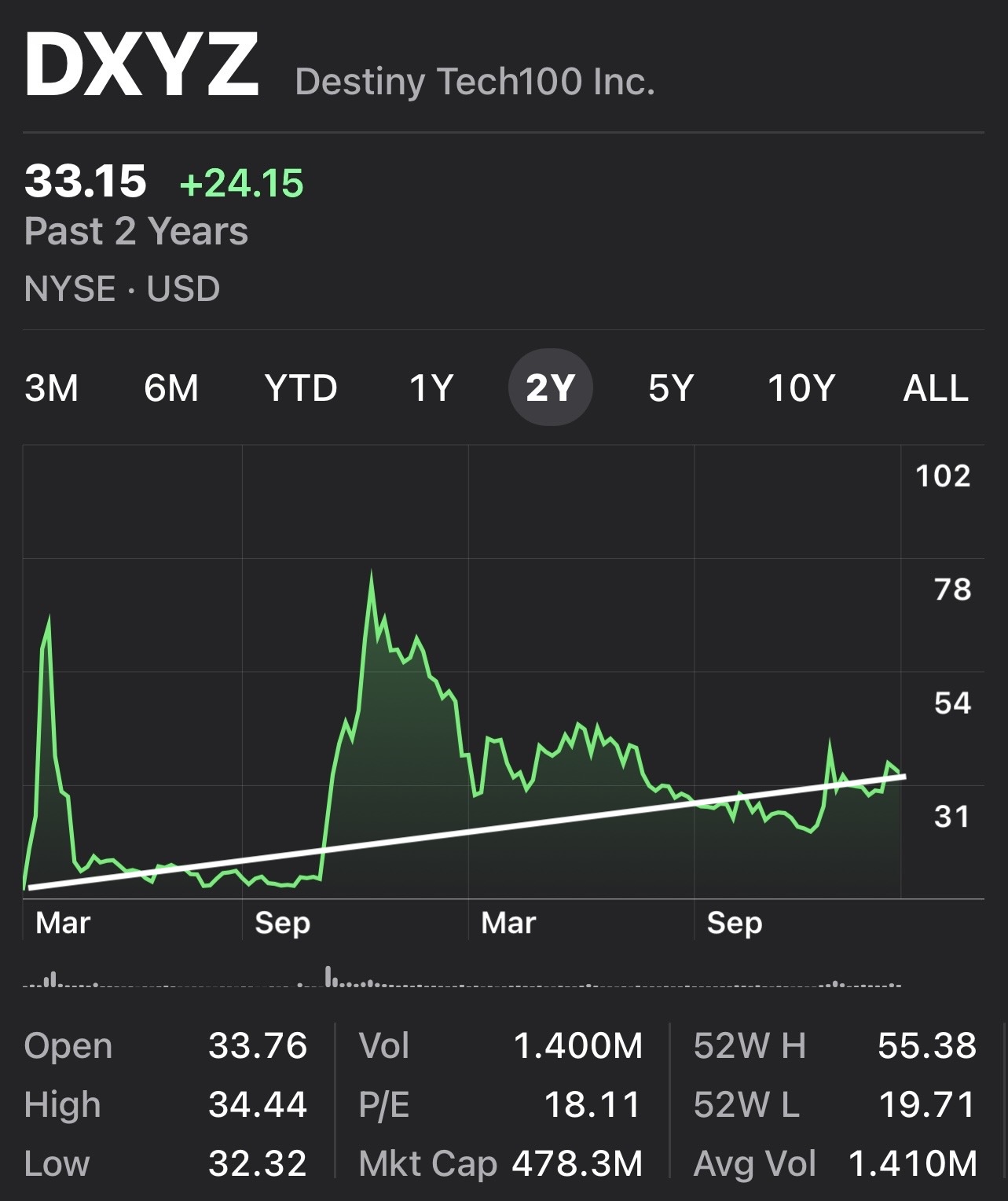
There is clear precedent for publicly traded funds trading at significant premiums to NAV. One notable example is DXYZ, or the Destiny Tech100 Inc. fund, which has traded at anywhere from a 200% to 350% premium to its net asset value. Back in November 2025, the fund’s NAV was roughly $7 per share, and it is likely higher today.
SpaceX accounts for approximately 52% of DXYZ’s holdings, which offers a strong indication of just how much demand there is for hard-to-access SpaceX exposure. Investors are effectively paying a substantial premium for convenience, scarcity, and perceived long-term optionality.
As a savvy investor, it’s reasonable to look at DXYZ and ask whether something similar could happen if the Innovation Fund were to become publicly traded. Based on a CNBC snapshot from 3Q2025, Databricks, OpenAI, and Anthropic together made up roughly 50% of the Innovation Fund’s portfolio. The remaining portion consisted of other high-quality private companies such as Canva, Anduril, Ramp, and, I believe, SpaceX as well.
One could argue that the Innovation Fund offers a more diversified mix of private growth companies with less concentration risk than DXYZ. If that’s the case, it’s not unreasonable to imagine a scenario where the Innovation Fund could trade at a meaningful premium as well, especially given how difficult it is for most investors to gain exposure to these companies directly.
NAV Could Also Decline As Well
That said, premiums to NAV are not guaranteed and can be volatile. Investor sentiment can shift quickly, particularly during market corrections or periods of rising interest rates. Premiums can compress just as fast as they expand, even if the underlying companies continue to perform well.
In addition, a more diversified portfolio may reduce concentration risk but can also dilute the scarcity effect that drives extreme premiums. Unlike DXYZ, where SpaceX dominates the narrative, the Innovation Fund’s broader exposure could lead the market to value it more conservatively.
All of the private companies held in the Innovation Fund remain scarce and difficult to access, even for well-connected investors. Meanwhile, ServiceTitan, now publicly traded under the ticker TTAN, represents less than 2% of the fund, reinforcing that the portfolio remains focused on private growth opportunities rather than public market exposure.
Taken together, a premium is plausible, but it should be viewed as optional upside rather than a base-case assumption. For long-term investors, the primary driver of returns should still be the performance of the underlying companies, with any premium to NAV treated as a bonus rather than a guarantee.
Let’s Make A Realistic Assumption Of NAV Potential
Let’s assume there’s a 50% chance the fund trades at a 10% discount to NAV, a 20% chance it trades at par, and a 30% chance it trades at a 50% premium (not 200% – 350% premium like DXYZ, which I wouldn’t buy). Under those assumptions, the expected value of a $100,000 investment made before listing would be about $110,000.
Even with a higher probability of trading at a discount, that kind of asymmetric payoff is still the type of risk I’m comfortable taking as a long-term investor. You should play with the assumptions yourself to figure out multiple realistic scenarios.
Personally, I don’t plan to sell for at least another three years, and ideally five to ten. My goal is to invest until my kids graduate college in about 16 years. Time and compounding are on my side.
Given the tax implications of selling, I would need a significant premium to NAV to be tempted. If I believe the fund can compound at 20% annually for several years, that’s roughly a 150% gain just by holding.
In that case, selling only makes sense at a large premium and with confidence I could redeploy the after-tax proceeds just as effectively. Otherwise, like many wealthy investors, I’d rather borrow against assets than sell them and pay taxes.
If the fund were to trade at an extreme premium, say 100% above NAV, I might sell 20% of my position to lock in gains and let the remaining 80% ride. That would be a miraculous ~$700,000 appreciation on my ~$700,000 total position just through a listing. Taking some profits balances prudence with long-term conviction.
Building Transparency, Liquidity, and a Brand
Having built Financial Samurai since 2009, I understand how difficult it is to grow a business and a brand. Sometimes momentum builds quickly. Other times you get dragged through the mud and suffer. That volatility is simply part of building something meaningful.
Fundrise’s attempt to list the Innovation Fund on the NYSE represents a step toward greater transparency, liquidity, and brand durability. It may also improve access to higher-quality deals over time, which is the main goal for both Fundrise and its investors.
The fee structure remains especially attractive. Being able to invest in private growth companies without paying a 20% carry is rare. One closed-end venture fund I invest in charges 3% management fees and 35% of profits. By comparison, Fundrise’s 2.5% fee with no carry is compelling.
The main challenge for investors, myself included, will be staying disciplined. Greater liquidity makes it easier to sell during downturns and to justify poor timing decisions with convincing narratives. I can make both a bull and bear case for almost any position I hold, having trained myself to look at both sides in an effort to avoid being blindsided.
And there will be a correction in AI private companies at some point. The real test will be whether investors can hold through volatility or even buy the dip if they believe, as I do, that AI is at least a decade-long trend.
Investing In AI For The Long-Term
Overall, I’m excited to see what happens. With a minimum investment amount of only $10, gaining exposure to the Innovation Fund is easy. If the listing doesn’t materialize, I’m comfortable with the status quo. And if Fundrise launches new funds investing in promising private growth companies, I’ll be eager to evaluate those opportunities as well.
Readers, what do you think about the Innovation Fund potentially listing on the NYSE? Do you expect it to trade at a premium or a discount to NAV over time? And would you consider investing before a listing to potentially benefit from any NAV expansion driven by supply and demand?
Fundrise has been a long-time sponsor of Financial Samurai, and I’m also an investor in Fundrise products. I’ve spoken with and met Ben Miller, Fundrise’s co-founder and CEO, many times over the years, and our long-term investment philosophies are closely aligned.
As with all risk assets, there are no guarantees. Please invest only what you can afford to lose and ensure your overall asset allocation allows you to stay disciplined through market cycles.
Read the full article here